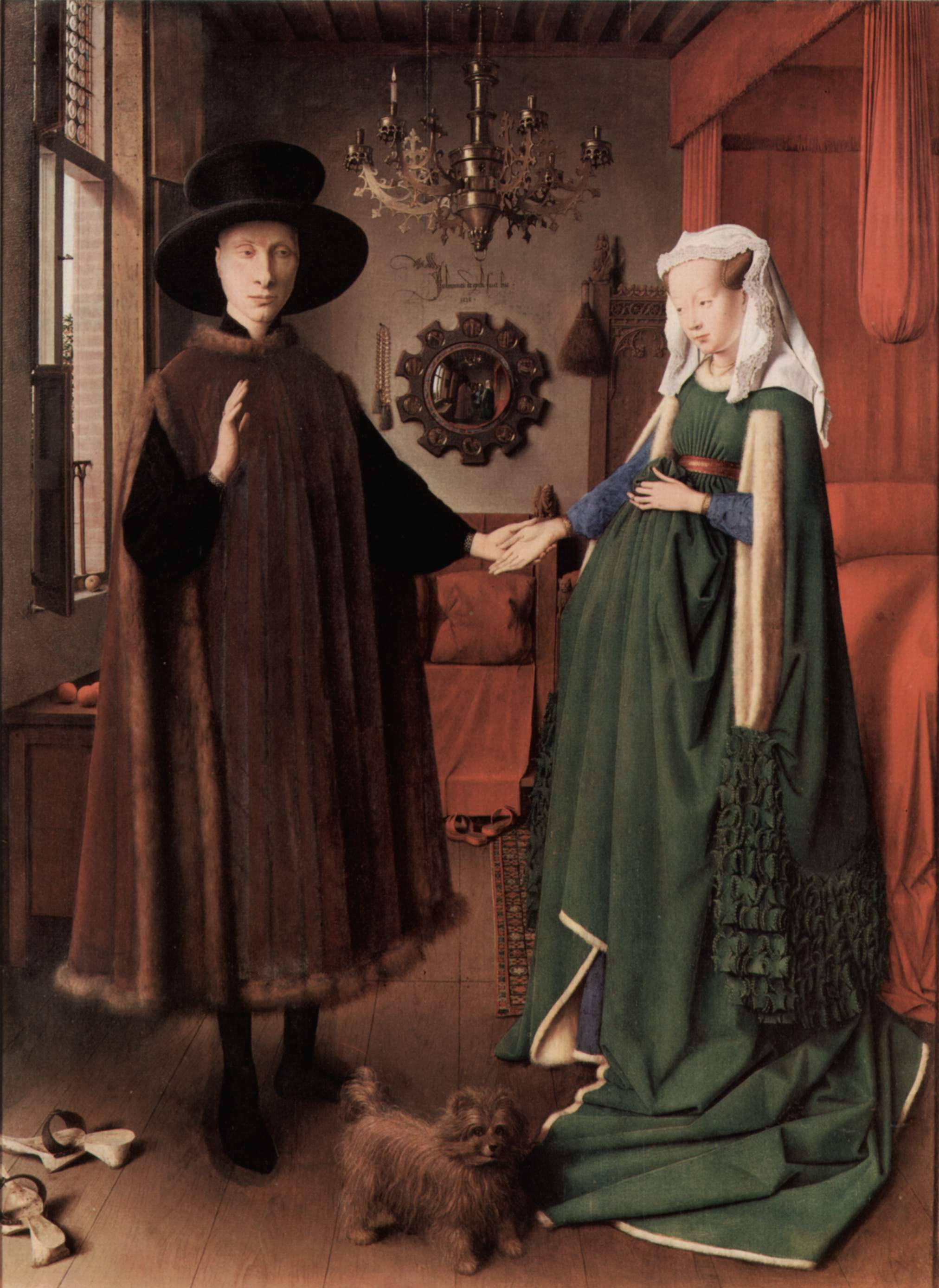
Thursday, June 4, 2009

What Errol Morris' Eye Missed. Part III.

The concept of the valley of uncanny is, at it's root, a theory of aesthetics. It's also one that has problematic aspects. According to this theory, a near miss beautiful woman will be less attractive than an ugly one. Not sure that works. I have something specific to write here, precisely because I have lived in the valley of uncanny for a while. The principle works, but not here with van Meegeren. This is because we don't have a good painter who first tried to imitate Vermeer, and found success with more distant, but plausible, paintings. We have someone who, as the images show, could not paint like Vermeer, but could paint in another style. The roots of that style, and it's components, are carefully enough explored yet.
Mass Versus Light in 1930's Modern

Creative review published a story on a New Deal typeface, designed for the movie Public Enemies. The creators wanted to capture the untrained aspect of Works Progress Administration art, often designed by professionals, but executed by people still learning. The modern made an explicit play of mass against light. Both could play either the good or the bad, such as in this example. The poster to the left makes light spindly play the villain. The rolls could easily be reversed, with dark blobs being crime and light being the cure.  

However the play, the power of this dynamic is made stronger by using blocks of light and dark, which make color and mass, that is cone vision, play against black and white vision, that is rod vision. Such as this advertising poster for the Cunard line.

This "Work with Care" sign shows
 mass associated with labor, solidity, care, stone, hardness, durability and survivability. Mass was good when it was associated with granite like permanence, a feature exploited in the travel America posters for both historic and natural wonders.

The two were often combined in a single message, for example in this 1933 Chicago World's fair poster, where towers are both solid and soaring.

The decorative arts style that is married to this idea of mass as solidity and permanence, is Art Deco. This was a movement that featured in it's first half rich colors of the prosperous urban jazz age, as exemplified by people such as the painter Tamara de Lempika. However, well before then, the aesthetic of mass has begun to emerge as being representative of certain kinds of values and qualities, both positive and negative.

The roots of this use of blocks of color came in the disintegration of impressionism as a movement, and the rise of Gauguin and Cezanne. The idea was to use planes of color, rather than lines, to establish space. It is not a new idea, but the modern is to expose the raw force of an idea, showing the way a particular effect is acheived. The faces of the van Meegeren owe a great deal to paintings like this nude by Gaugin and this figure portrait.

Fauvism was among the first art movements of the new century, and it showed the traits of which van Meegeren's faces would partake: the planes instead of the lines of the cheeks, for example.

Meegeren, by tossing aside pastiche, has adopted his native century. But he always had, his textile in one painting marked where he was, and dated him. Now he was free to paint in a style, and strangely, still inexplicably, he chose one that evokes Mann's Death in Venice: a fascination with the vibrant and latin south. For van Meegeren, the context of Spanish references had to be ironic given the history of the Netherlands as a once Spanish colony. Looking again at van Meegeren, who had a villa in the south of France, it is clear that he has become enamored of the rich mahogany skin of distant place. He is enamored of Mexico and other places populated by dark beauty.

The Third Reich famously adopts this aesthetic of mass, exemplified by films such as The Triumph of the Will. The use of the German Eagle in their propaganda is one such powerful motif. But they are far from alone in using mass and associating it with state power. The Soviet examples are myriad. But this use is not limited to totalitarian states. Here is, for example a contemporary Federal Reserve eagle, and this one from Canada. 

So the use of mass as a sign of permanence is part of the period aesthetics, and part of the dialog of light and thin against massive and monumental. Mass, implying the ability to extract and process large volumes of ore into steel, is a trope that had appeared in previous eras, with for example, gothic stylings in the Victorian, or Ming tombs and the Forbidden City. Mass is a way of a society demonstrating it's physical force and ability to project power through labor and capital. It is an idea that powered Stonehenge, the Inca cities, and the massive Egyptian pyramids.

The aesthetic of mass had many reasons to flower at that moment,in that form, and several of them can be associated with the results of that wave of capitalism: giganticism, materials, pollution, and mass urbanization, as well as the technologies of reproduction themselves, such as silk screening. Silkscreen creates areas of lighter or darker application naturally, and art works that use large blocs of color are often better recognizing the properties of the medium.

The 1930's adopts a palette of earth tones and sombre colors, which was coupled with the sense of darkness, despair, hard labor, but also massive industrialization. It was a period of large projects, precisely because labor and capital had become very cheap relative to the cost of money. In the United States, that produced the WPA, in Germany, the creation of a war machine. But the same aesthetic is at work: mass implying permanence, power, and purpose.

van Meegeren is hardly in the forefront of this aesthetic movement, or its use. From from being a generative force, by the time he adopts these tropes, they are already well established, and had been used in both high and commercial art for decades. Nor is his application of them particularly revelatory. His Vermeer-van Meegeren period is a mannered application of these forms. 

Apocrypha

Apocrypha is the attribution of works created of whole cloth to another figure. Almost every important writer, artist, or creative person in history, from ancient philosophers forward, has works attributed to them. Some are not intended to be mistaken for the real thing, it is merely the way of that time and place. Others are clearly intended as forgery in that they are meant to be included among the works of the individual and expand the corpus. To be, as it were, the first among interpreters. 

However some are even broader in intention: to be a rewriting of the meaning of the individual or the individuals actions. Apocrypha of this time are very different from forgeries, in that the forger is trying to create something that is very much alike the artist or figures output, only with their own ideas carried along with them. The creator of apocrypha is making a second creation: asserting their own equal genius, and in some way, erasing the figure that came before. 

van Meegeren's work fits this description. It is art, where his pastiche was not. It is utterly different from Vermeer in almost every respect, fitting closely the aesthetics of his own time, in it's use of planes of color and abstraction, Gauguin and Cézanne derived techniques. He sits comfortably among contemporaries such as Diego Rivera, for example.

The creator of apocrypha, however, has two final twists to answer for, and these call into question the theories based on people merely fooling themselves about the nature of the works in question. 

What Errol Morris' Eye Missed. Part II.


So the first period of van Meegeren the forger is as a producer of pastiche. He knows the elements of a corpus and puts them together. In his second period, he makes things of a new style, one that is totally unlike Vermeer. Except for one thing. It's art.

Bad art, but art.

Huh?

kk here we go.

The painting at the right here is the only Vermeer religious genre that we have. There may have been others. The painting at the left is a similarly seated version by van Meegeren, but it is not a Vermeer, or even a cartoon of one. The problem with the "Valley of Uncanny" explanation, as clever and witty as it is, is that this painting can't pass for something which is even a sketch of a Vermeer. It is wrong in a dozen ways, and it is linked to a larger 20th century string of aesthetic ideas. It's also genuine, and not a fake. Not in the sense that it is what it was said to be, but it is a painting.

Look at the painting on the left. Where is the artist's eye focused? That's right, on the penitent pleading with Jesus. Look at her face, it is detailed. If you stare at it, even in this picture, the rest of the painting becomes 3D. Jesus and Mary washing his feet foreground nicely, the bread and the woman bringing it are in peripheral vision, and the figure in the background looking down? drops to the correct background. 

In van Meegeren's mind, without a doubt, is a virtual world: he can place figures in it, move objects, and not only are physical external details in the correct place, despite the anti-realist aesthetic of the painting, but the artist's vision field is there. This is not a pastiche, it is a painting. It is one of the wrong aesthetic, and one of an inferior artist to Vermeer in a host of ways, it is laboriously mannered, and even takes some traits of mannerism and other earlier styles. Compare the faces with this one by Jan van Eyck.

This is where the differences between object and reception stand out. In the last century, there has been extensive argument about object and reception. The extreme view on one side is that there is no object separate from it's reception. Stories like van Meegeren help prove this in the minds of it's believers. There is no truth, only the stories we tell about it. On the other side is the view that there is real reality real real, repeat that a few more times: real real real, that we can put in our brains and have like a pencil. Most people are clear that these positions are the kind of thing that aren't really true. (uh hu, intentional)

The case of the first van Meegeren we looked at was that it was not a copy, in that there was no original. It was a pastiche, in that it was not an original in itself. van Meegeren had no command over his parts, and where he did not know what to put, because he couldn't include all copies of bits of originals, he failed. Music in the wrong place, bowl of fruit that was wrong, wrong tablecloth. The lack of unity is seen in the lack of the artist's field of vision. The first van Meegeren was a fake.

The second painting, while obviously in an inferior aesthetic, is not a fake. It is a genuine painting. There are no pastiched elements that have not transmuted to the visual language of the painting. The artist's field of vision is present. It is attributed, however, to Vermeer. And while money is part of why, it is also not the whole of the explanation.

To see how this works, let's take a copy, that is not a copy.

The first painting to look at is the original (link to the essential Vermeer page) and then to a painting that is in the American National Portrait Gallery. The copy has aesthetic problems. Vermeer's famous earring, but on a peasant girl, not a house servant that might be legitimately wooed by a gift. But the more fundamental problem is that she is out of focus, and in a portrait, that looks wrong. It should. On the right is the original. The face is blurry because even though the girl looks to the painter for approval to have the wine as the young man leers at her, the painter is not meeting her gaze. The detailed area is around the cuff, the cloth, the vase the top of her dress. The power of the story here is quite sharp. The girl is asking for permission to enter the world of adult sexuality, and the onlooker cannot really bear to watch.

Stripped from context, the copy is no longer a copy, because elements of the original that made the face make sense, are gone.

I want to go back then, to the late period. In contrast, the pieces are not ripped from anywhere else. We are not seeing "collections of Vermeer quotes" as one art critic put it, but a whole visual language. The reality of this language goes far beyond volk-kitsch Nazi theorizing of art, it goes to the language of it's time, and to a broader language, which is the language it's purpose itself. Paintings, all objects, speak to their time, but they also speak to their purpose, which recurs from time to time, and too which we look for meaning and pasts to connect to.

The painting here is not a copy, not a forgery, it is a new style of art, on top of which is placed Vermeer's name. It is intended to erase Vermeer and replace him with van Meegeren, and thus allow van Meegeren to do what he can't do with pastiche: actually paint. van Meegeren cannot assemble quotes into a usable whole. It isn't about closeness to Vermeer, and a valley of uncanny, but that van Meegeren cannot paint in quotes. He can paint in this other style. The ersatz Vermeers are not "close but wrong," they are just wrong. No one can honestly believe they are by a great artist, once you have seen what a great artist looks like, let alone a particular great artist, because they lack the unified language that their surface suggests they should have.

By trying to copy and pastiche, and produce forgeries, he managed to not produce actual paintings. That van Meegeren was a careful forger can be seen from his way of doing forgery, and this to reflects an aesthetic series of choices. van Meegeren came to understand that if he wanted to make paintings that would be taken as Vermeers, he had to produce paintings. It was not a matter of close to Vermeer inviting close scrutiny, it is that van Meegeren the pastiche could not withstand that scrutiny.


What Errol Morris' eye missed. Part I.


As a regular reader of Errol Morris' blog, the series on "Bamboozling Ourselves" 1 - 2 - 3 - 4 - 5 - 6- 7 , has been my first blog read in the morning since it started, it touches on art history, and the development of both the aesthetic and scientific elements of the discipline of art history. The subject is the career and activities of Han van Meegeren, the forger who created a long series of paintings, palming them off as works of the Dutch Golden Age, a period which encompasses the 17th century.

Morris takes as his point of departure the two recent books on van Meegeren, one by Jonathan Lopez, one of the amazing rising bright lights of Art History, whose The Man Who Made Vermeers is a rich historical biography that assembles the essential facts of van Meegeren and his career; and Edward Dolnick who has essentially written a thriller about a forger and attempts to ground that story in the theory of virtuality.

Wallpaper (That Which Surrounds Us)

The reason I write on this is that there is a bias here: namely the bias which feminist theory would label "logocentrism:" an obsession with origin and with the importance of creativity as the focal point of examination. Morris is looking at the works of genius, or sub-genius in the case of kitsch art. But he ignores important evidence that comes from the ordinary. As someone who studies the ordinary, there are crucial details which change the story entirely. This is a critique, not an attack, on the brilliantly important work being talked about in these posts. It's not too much to say that Lopez' book will repay almost every minute you spend with it.

But there are a few more minutes that would help. 

The arc of van Meegeren's career is that he learned the late 19th century style, and some of the 20th century technique of art. He attempted to paint under his own name and then began creating ersatz works which he sold into the inter-war art market as from the Dutch Golden age, claiming that these were from private collections which were being sold under some form of financial duress. 

In the 1930's with the rise of Nazi-ism, he began painting paintings attributed to Vermeer, but in a completely different manner. It is this change of manner that is important, because under this new style, he was a raging success, where as before he had been hit or miss in his creations. The explanations as to why are offered by Dolnick: in that the old style was "too close" and invited scrutiny, where as the new style was farther away and "Vermeerish" and acceptable, in the same way a cartoon is cute, but a corpse is not.

Let's take a comparison of the two works: the one on the left a van Meegeren, the one on the right, a Vermeer. It is clear that van Meegeren had that Vermeer as part of his source material: the sleeves and genre elements are copies. The window is of the same kind, the lighting is the same. An art historian with modern eyes would then begin comparing the techniques: is the light the same? Is the handling of the face as artistic? Does it create in us a warm sense that a "real" Vermeer has. This notion of viewer as consumer, and the viewers pleasure as the reality of creation turns a creator into a brand name. We want the Vermeer thing, we go to Vermeer.

But the problem with van Meegeren is that he isn't there. He can pastiche elements, but the scene isn't real to him. We see this in some simple things: first, the music is in the wrong place. The girl is tuning the guitar and looking out the window, but the music is at the wrong angle to read. One can create perhaps of a story, buy that is also a modern convention. There is no story to a pose picture, save that the artist wants to create by posing. There's no story that has someone else put the music there, and then she sits, because, as we see from the mirror, the other person is also sitting behind something, an instrument perhaps, or embroidery. 

But this is playing the game of details, and invites Dolnick's argument of the "valley of uncanny." that is close things invite close scrutiny, while farther things are seen as cartoons. The obvious game changingly wrong thing in this painting is on the lower right hand corner. The table cloth. While the van Meegeren here can pass for a Dutch Golden Age painting in bad light at a distance, or in that shot, at an angle in 3D, though not by Vermeer for artistic reasons I will get into, it is only by special pleading. The table cloth, you see, is all wrong aesthetically.

Let me post a closer comparison, again in 3D, for reasons I will get to in a moment.

The fabric on the left is typical for Vermeer and his period: it is a rich pattern. In an age when everything is bespoke, made for and by the instructions of the client, richness is richness. There is an aesthetic at work here: the merchant or other wealthy person gains power by appealing to the tastes of those he deals with. He hires a painter to make an object, to his taste. Naturally every object in the painting is going to establish that same individualized craftsmanship. Painter, vase, and tablecloth. 

Now, look at the van Meegeren. There is nothing wrong, aesthetically, with Pueblo Indian primitive, or any other from of geometric primitive. However, it is out of place in a Vermeer period work. Look at every tablecloth in a painting from the Vermeer, and there will not be one like this. Because in the imputed period of that table cloth, the Dutch were not interested in that kind of aesthetic. It speaks of a different kind of relationship with nature and with artistic output. One look at the table cloth, and it is clear that the earliest possible date is much later.

One can then spot the reason why, even if this were Golden Age, it would not be by Vermeer. The reason sits in plain sight to any one who can draw. The fruit bowl. It is a knock off exercise of the gestural school of drawing now exemplified by The Natural Way to Draw by Kimon Nicolaides, unpublished at his death in 1938, but a summation of the way that drawing was taught then, and to a great extent, now. drawing is dancing over the page with marker in hand.

The reason we know the painting is ersatz, and not done from life by an artist, is a matter of 3D vision. That fruit bowl is impossibly sharp, unless the viewer is looking at it. Now the aesthetic of looking in paintings is not universal. There are plenty of times and places where it is impossible to identify where the artist is looking. It is a matter of the relationship of painting and viewer. In Vermeer's moment, part of what made him an in demand craftsman, was that he was inside the life, and his paintings have virtuality to them. The viewer can tell where the eye of the painter is focused, and the rest of the painting make sense in sharpness. In the Vermeer, the painter is looking directly at the woman's mid-section. Everything gets blurrier away from that central area that stretches from the arm on the window to that midsection.  

In the van Meegeren by contrast, there is the mirror that is sharp, the light from the window, the hand. In short he is engaging in pastiche. He is taking elements he knows from paintings, including the Vermeer, and piecing them together. But pastiche is not an aesthetic of Vermeer's work, or of this genre. It is in other places in that time, specifically, allegory paintings. But not  in domestic works. Thus van Meegren, despite pastiching the time, makes several errors that mark him as probably being from the later part of the 19th century, or most likely the early 20th century. 

This is because for Vermeer, the scene exists in his mind in 3D. If he moves something from where it actually is, it takes on all the qualities of being moved. van Meegeren can change perspective and lighting, but not the field of view. Nor does he want to, in a deep sense. More on why in a moment.

The reason I place these in 3D is that in a flat book, it is easy to miss the virtuality effect that Vermeer creates. Without lots of distance to create 3D perspective, he needs to buttress the effect by the field of vision. van Meegeren juts the table out forward, which is not an invalid move, but does not do other things.

The Ahistorical Historical Eye

But the analysis I just did is ahistorical. It relies on something that was not present at that time: a highly educated eye, and self-placement in history. Both are not present in 1930. 

The first part is easier to explain. I've seen much of the publicly available Vermeer corpus. But I know that it is, because people have filtered out "not-Vermeer" for me. I know what people tell me a Vermeer looks like. I've also seen reproductions of thousands of paintings. In other words, an ordinary art history student of 2009 has the visual range of experience of only a few people in 1930. The reproductions I have seen are better, not black and white plates or drawings, but large glossy originals, or slides taken in 35mm with precise lenses and exacting lighting. The ordinary reader can go check the paintings themselves. 

This ahistorical sense of knowledge of the past makes it hard for us to understand a time when a close Vermeer might have been accepted, simply because the sense of Vermeerness was not as firmly entrenched. 

The second part follows from the first. We can all look, we can all comment. We can all exchange. There is a relentless mill of comment which was not the case then. Now days or weeks might pass before one person reads an important paper. Maybe months. But important works are far less likely to remain hidden. This crops up in Lopez' revision of van Meegeren: by looking at the signature, and putting the picture forward, he obliterates the myth of van Meegeren the pankster. But before, an expert could dismiss it, and people believed that dismissal.

If van Meegeren's early "ersatz" period works had merely been fobbed off as real, and they were, this would not be much of a story. There have been hundreds of misattributed, or forged, paintings in art history. Over 400 paintings have been removed from attribution to "Rembrandt" in the decades of the post-war era. What is important is that van Meegeren was not creating copies in his second period, nor pastiched forgeries, but something else.

Apocrypha.


Virtual Selves On Hollywood's Mind

Willis in the noir-esque secret conspiracy version of analog avatars.

Wednesday, June 3, 2009

I was going to write something

and the person who I was going to write it about knows who they are. I might still, if there are any further problems from that person. But I won't. She has a bad rl. She has a bad family. She is trying to make something of herself. She is making some big mistakes, but in sl, which is for making mistakes in. She abused me, and was utterly contemptible in her dealings with me. She is like a thousand little tyrants in sl.

I hope for her sake, and the sake of her children, and her rl, that she learns that not everyone in this world is to be treated like dirt, and that if you want employees, then you have to pay people real money. Because that's what we trade work for in real life, we let some one abuse us and treat us like a child, in return, we get enough money, we hope, to walk out the door and live.

This is a common sickness in real life, and second life shows it. But when I sat down to write this, again, absent more abuse from her or her people, I thought not of her stupidity, but of her children, who, I hope, know nothing of Second Life, and who deserve something better.

That's all I want to say at the moment. Perhaps it is too much, perhaps not enough.

I'm going to build a maglev in sl

I'm going to open source it.

So now we know where all the Republicans will be yiffing

Straight from the General.

Sunday, May 31, 2009

An observation from "The Tall Book"

Arianne Cohen on choices in life:


Height makes a great case study, because height statistics are easily quantifiable. Tall women have half the birth rate of shorter women. "It's not related to lower fertility," says anthropologist Boguslaw Pawlowski, the pre-eminent mating patterns researcher. "It's the same with short guys. They are not limited by sperm quality or hormone level - they've got problems with finding a partner." In the population at large, women typically date men who are 8% taller. This is a boon for the women below the 50th percentile, who have 99 per cent of men to choose from. A 6ft 3in woman is looking at less than 3% of the male population. Extrapolate freely to the choices you make in your own life.

I had six months with Alan to let Dodson's words marinate before the relationship imploded. The truth was that despite getting along famously, we had little in common. No tall joke could save us. And in the two years since, I haven't kissed anyone taller than me. Don't get me wrong, they're still tallish - the 6ft DJ, the 5ft 11in triathlete, the 6ft 1in actor. But my dating pool has expanded by 3,000%. I'm happier.

Earth Water Fire Heavan

The soil is stuck between my toes as mud.
There leaves a stream of foot prints behind me.
It bakes to gorges for the ants,
who reflect how these hills were born.

Friday, May 29, 2009

Why not just call the sim Dachau

Everytime Ll puts in content or transaction controls, it breaks the grid. This time is no exception, their recent adult content campaign, while it is necessary to sell to corporate clients, is worse than the breakage after the gambling ban. Crashes are proliferating, and the mechanisms to enforce create zones of unusability. More over they are going to force people on to 1.23 soon, while that build is still hopelessly buggy and crawling with problems. 

The Lindens have set up a series of "oatmeal" sims to test their new found totalitarian spyware. Why don't they just call it Dachau? Or Gitmo? Or some other place befitting what it is, an attempt to set up a thought police system that monitors thought crimes? Because that would be bad marketing. 

Now realize that I am in favor of segregation between sex seeking behavior and other places. I don't want people hitting on me when I enter a business conference, I don't want to have a skybox and then next day a strip club goes up next door with people spilling over. There's no question in my mind that behavior needs to have it's time and place. However the content controls don't do that. When landing in the PG sim, what was the first thing that happened?

You guessed it, an IM saying "Hey sexy!"

I then tried to walk on the PG sim, and it kept crashing me through the land down into negative numbers. That's right PG. I am on 1.22 but am verified, it would not let me into the adult area. So the answer to what is going on is very simple: it is broken, it is borking the rest of the grid, it does not work. I found a way to get into the sim easily enough based on a well known bug. They will fix it, but there will be many others.

Finally it makes me believe that the new avatar rendering, where only the final baked copies, are for nothing other than copy protection, and to prevent "naughty bits" from ever touching other people's computers.

Now LL allows child pornography in second life, in that it does not ban people who skirt the edges of obvious even when they do it in public and are reported. So they cannot take any kind of moral high ground here: they do not enforce the ToS or the law when it is not convenient to do so, but are spending virtually all of their programming resources to do this. No wonder so many techies abandoned ship. 

This is what LL spends it's time doing: breaking the service that people pay money for in pursuit of goals of questionable utility.


Thursday, May 28, 2009

Dkos's KagroX on VS Tonight


It is at 6PM SLT at n World Studios. SCKendrick is the host.

Dreamtime Identity As Virtual World

Far off in Dreamtime, there were only people, no animals or birds, no trees or bushes, no hills or mountains.
The country was flat. Goorialla, the great Rainbow Serpent, stirred and set off to look for his own tribe. He travelled across Australia from South to North. He reached Cape York where he stopped and made a big red mountain called Naralullgan. He listened to the wind and heard only voices speaking strange languages.

This is not my country, the people here speak a different tongue. I must look for my own people. Goorialla left Naralullgan and his huge body made a deep gorge where he came down. He travelled North for many days and his tracks made the creeks and rivers as he journeyed North. Goorialla made two more mountains, one of the Naradunga was long made of granite, the other had sharp peaks and five caves and was called, Minalinha. One day Goorialla heard singing and said, "Those are my people, they are holding a big Bora." At the meeting place of the two rivers, Goorialla found his own people singing and dancing. He watched for a long time, then he came out and was welcomed by his people. He showed the men how to dress properly and taught them to dance. A big storm was gathering, so all the people built humpies for shelter.

Two young men, the bil-bil or Rainbow Lorikeet brothers came looking for shelter but no one had any room. They asked their grandmother, the Star Woman but she had too many dogs and couldn't help them. the Bil-bil brothers went to Goorialla who was snoring in his humpy but he had no room. The rain got heavier and the boys went back to Goorialla and called out that the rain was heavy. Goorialla said, "All right come in now." The Bil-bil bothers ran into Goorialla's mouth and he swallowed them. Then he began to worry about what the people would say when they found the boys missing. He decided to travel North to Bora-bunaru, the only great natural mountain in the land. Next morning the people found that the boys were gone and saw the tracks of Goorialla and knew that he had swallowed them.

You may never see these lakes or mountains, but after the rain you will see his spirit in the sky , which is the rainbow. This is the reason why he is called Goorialla the Rainbow Serpent.


The Dreamtime Identity

The "Dreamtime" of the indigenous Australians is a virtual world. Since there is no commonly accepted definition, we are still in the range of analogy. However, the most crucial point is that Dreamtime is recognized as a different time from real time. Dreamtime has its own properties and its own rules. The state of virtuality is maintained by Derridaidian play. Something becomes part of Dreamtime the way a twitter topic rises: people accept it and use it. A hill gains a song line, when people recognize the hill, and use the song line. Dreamtime also has correspondence in that object in Dreamtime have real equivalents, hills, events, people. (Archaeology of the Dreamtime Josephine Flood, Yale University Press 1983, rev 1990)

The time aspect of Dreamtime cannot be understated, the time structure of Dreamtime is that it has an infinite past which set the state of the world, a past where actions happened that are reduced to songs and stories, a present which is the telling and the observing of Dreamtime, not the doing. Finally the future is part of the present, in that prophecy, and return are incorporated into stories, including stories of the removal of the Europeans. As a time structure, where eternal past, perfective past, imperfect past, and unrealized future all cohabitate, essentially differentiates Dreamtime from the real time world. 
Flood draws a picture of how complex the Dreamtime apparatus was, with trade networks, ceremonies and gatherings forming the crucial core of the maintaining of the integrity of the stories, and paintings and other objects used to make physical and visual the concepts. A virtual world turns principle into to visible and audible, and this the dreamtime did.

No single individual was the arbiter of Dreamtime, instead, Dreamtime, the collective, was seen as the arbiter of human morals. Meggit in 1964 summarized the situation of the Dreamtime thus:
this was balanced by thecomplexity of their religious ideas and the elaboration of their ritualactivities, which the people themselves regarded as intrinsically signi-ifcant techniques for ensuring productivity of man and nature. Thesestemmed from, and were important features of, the pan-Australian totemic philosophy — the view of the universe that regarded man, society and nature as interlocking and interacting elements in a larger,functionally integrated totality. According to Aboriginal belief, each variable in the system had an eternal, moral commitment to maintain itself unchanged for the benefit of the others and to contribute to the proper functioning of the system as a whole. As the mythical ancestors and culture heroes of the long past Dreamtime had defined the characteristics of the totality once and for all when they had participated in its creation and shaping, any subsequent change in any variable would inevitably affect the whole — and that for the worse. Thus it was the duty of every man to ensure, mainly by magico-religious means, that the status quo be preserved, an obligation that obviously ruled out most possibilities of cultural innovation, whether in the sphere of technology or of law.

This kind of world-view emerged clearly in the Aborigines' attitudes to their homeland, be it the narrowly bounded habitation of a coastal fishing group or the vast domain of wandering desert dwellers.

The territory was of course the main, if not the sole, source of food for the local unit. Even if, as was sometimes the case, the group hunted and foraged freely in the districts of similar neighbouring units, it had unequivocal title only to its own land, to the land with which it had spiritual bonds. That is to say, tribesmen did not acquire or inherit only the right to exploit the material resources of the tribal country; they also received the double privilege and obligation of maintaining the sacred tracks and sites of the ancestral and heroic beings who created the land and all its inhabitants. Here maintenance did not mean mere protection from trespass or desecration but rather that certain groups, associations, or lodges oft ribesmen were also expected to preserve and transmit unchanged the detailed myths and songs that recounted the exploits of the Dreamtimecreatures and to perform regularly the quasi-historical and religiousrituals that re-enacted the events of the Dreamtime.


In short, the Dreamtime was not unlike a large computer system, which ran somewhat without reference to the people using it, but which had to be maintained, by symbolic means. Maintaining the land was done by maintaining the stories. The stories represented the true virtual land, which present activities represented deviations from.

In modern times, we would call them "malfunctions."

Meggit's interest was in whether the aboriginals exercised self-government. Early observers from Eyre forward did not see what the natives did as "government," in that there was no command and control system where orders where given and followed. But this is a rather narrow view of government, because while commands are one way of multiply power, they are not the only way. Economic power is another, but the aboriginals did not use much in the way of economic power. A third kind, which they possessed, was cultural power, and despite there being hundreds of languages and dialects, among only a few hundred thousand people, the system was continent wide. This means it covered a larger area for a longer time than any other stable religious system before writing.

The argument for Dreamtime being a virtual world then rests on the following points:

Separation the first and most obvious pillar is that it was seen as separate in time and space and mode of participation from the real world. The story above begins with this assertion. Note that serpent is not an animal but a person.

Correspondence Never the less, the Dreamtime is the real world, in that every object and event of importance has a corresponding piece in both worlds. Even pieces that do not exist, such as describing the still towering barrier reefs that the first people crossed to come to Australia. Stone artifacts are found under the sea, where these reefs are now. In the story above, the territory of the rainbow serpent people is defined by the mountains that he makes as boundaries, the gorges and the rivers that are their sustenance. However, it is not a simple demarcation of area: there is the story of unification of the wandering serpent, who then swallows the two boys. This means that there was a union of groups in this area. The serpent sacrifices the two boys, and is an outcast as a result, in a very old pattern. Since the world snake is creating this entire region, it is the boundaries of Australia, and his people came from over the sea. This myth then represents events of as long as 70,000 years ago, and at least 50,000 years ago. That it does so comes from it's description of geography, which is not that of the present, but of the time when Australia was drying out.

Interactivity People can change the Dreamtime by adding stories, as stories were added after the European invasion, and these changes resist and accept. Not all new stories spread. In another version of the myth, the boys are cut out of the serpent, and have become rainbow colored birds, Goorilla then flees and instead of being a rainbow, is a shooting star. That there are different versions is interactivity, but the interactivity is also affirmed in the myth: people can over turn the decision of a spiritual god. 

Another indication of cultural evolution is the evolution of paintings, from the first period which depicts extinct animals, to the land period where hunting animals are show in the "polychrome x-ray style" which shows spines and internal organs, to the estuarine period which focuses on fish, to the contact period. First they lived off of the native life, then they hunted the animals that were too swift to easily fall, then they fished, then they were conquered. 

Impersonality No individual is in control. This point is also made by the paintings: the changing of the world was not something the natives could control. They could slow change, and you can see why from the long history why they saw change as bad: from a wet fertile continent, to a dry and difficult one, to an invasion. Change means change for the worse in their long context. 

But these are traits of a virtual world, not a definition. The definition is found in the ability of individuals to absorb themselves in the "world" and for it to react back. It must have "worldness." As the name implies, dreams have while they last, the seemingness of wordness, but it fades, it does not have persistence, which is an attribute of impersonality. Games have interactivity, but they are only forward interactive. I mean this in the broader sense of a game. Thus I can read a novel, but I cannot change that novel. I can only change how other people read that novel by writing in turn. Games are forward interactive,  virtual worlds are two way interactive. This creates a range, from pure games, to the worlds. However, since the real world has aspects of both, there is no collapse into one form. Instead, both have  degenerate form. A world or game that loses its players, or becomes completely idiosyncratic, ceases to have the features of a world or a game

This in turn highlights an important conflict that will be detailed later in the quest for virtual identity: that of optimal against anti-pessimal strategies. An optimal strategy is one that has the highest mean return, an anti-pessimal strategy is one which avoids the worst unacceptable outcomes. As the story shows, the pessimal result for the boys was being swallowed, having too few huts was culturally optimal, but not anti-pessimal.

The Australian Dreamtime then, shows us what a virtual world without electronics, or even paper, looks like. It as a separateness which none the less produces a correspondence, it is interactive both with words and actions, and it runs independently from any individual desire, rather than being arbitrarily changeable.

What does this mean for virtual identity, to do that, we need to look at the Shaman as a figure and why he represents a virtual identity.

Bibliography

Arden, H. 1994 Dreamkeepers: A Spirit-Journey into Aboriginal Australia

Flood, J. 1983 rev 1990 The Archeology of Dreamtime, Yale University Press

Meggitt,M. J, 1962 Desert People, Aboriginal food-gatherers of tropical Australia, Proceedings 9th Technical Meeting, International Union for Conservation of Nature

Meggitt, M. J, 1964, Indigenous forms of government among the Australian Aborigine

M. K. Organ, 1994 Australian Aboriginal Dreaming Stories: A Chronological Bibliography of Published Works 1789-1991

Povinelli, E.A., 1993, 'Might Be Something': The Language of Indeterminacy in Australian Aboriginal Land Use, Royal Anthropological Institute of Great Britain and Ireland.

Wolfe, P., 1991, On Being Woken Up: The Dreamtime in Anthropology and in Australian Settler Culture, Society for Comparative Studies in Society and History.


Wednesday, May 27, 2009

Dreamtime Identity Begins.

Identity has three parts. There is inner identity, that is how we feel or experience ourselves. There is presentation, that is how we assert that identity to others. 


Inner identity is something our brains do. It is not a noun, it is a verb. It is an activity to create identity inside. This is evidenced by cases where people lose their identities. Dissociative Identity Disorder maybe rooted in a seizure, or seizure-like condition, of the left temporal lobe producing several identities which can co-exist. 

There are also short term identity lapses. These have no exact understood physical reason. The most common is the dissociative fugue. This is characterized by a person simply leaving their old identity, often fleeing to some place far away, or forgetting the details of their old identity. It is not common, but not that uncommon either. At two tenths of a percent of the population, you probably have met more than one person who has experienced it.

It is for these reasons that critical theory describes identity as "constructed." However an even better way of putting it is that identity is maintained. The assemblage is still present, and in the case of dissociative fugue can be reassembled.

This is inner identity, or rather inner personal identity. Even when the personal identity is lost, other kinds of identity remain, such as national or gender identity.

There is also role, which is how people present their identity. Role and identity are related and reinforce each other. It is an old observation that people become the parts they play. When most people talk about identity, what they really mean is the interaction between inner identity, and role, that is the expression of identity. 

Roles involve both habitual behaviors, and provisional ones. The involve props, activities and other "proofs" of identity. Much of role creation involves creating habits. This means that role becomes part of the substance of inner identity, we keep doing our role even if we forget the identity it is part of.

Then there is the public identity that other people ascribe to us. That is, the name on the driver's license, or on the user account. The face, the  style, the pieces which allow people to place us in the world. To see where we come from, to see what we have at risk. Our public identity is often associated with what we have to lose.

These are not isolated in the sense that we have an inner identity which is pressured if it is not accepted, we present that inner identity, and learn behaviors that get the right response from the world. If a person has an identity as an athlete, they will do what needs to be done to run races or whatever their competition is. If a person has an identity as a femme fatale, she will learn to dress and walk and talk the part until it works.

Identity fragments when the inner activity of identity can no longer take the behaviors, memories, touchstones of identity, and get the results back from the world. When people treat us because of our public identity in a way different than that accords with our inner sense of ourselves, we often shift that public identity.

Now, since one can't start out with a successful identity, and because we often want to try on identities that we cannot wear, there is "play" and imagination. We often dream or imagine ourselves with other identities, whether it is a different body, or job, or spouse in a dream, or playing a game. We call them plays because people play identities.

Identity then is three parts, and virtuality is the place of creating a different road to identity. The first road that I have described is the road through interaction with a fixed outside, and a largely fixed analog avatar. It invovles shaping that avatar, and the inner identity, to match what works with the interaction of the outside. In a virtual situation, the world, and the avatar, are changed to meet the identity, and the interaction is with this changed avatar. Since there is no firm line, all real changes also involve some amount of changing the world: making acceptable what was not. This goes back to the triad of the negotiation of desire, possibility, and acceptability. Inner identity is linked to desire, the role is possibility, and acceptability is public identity. 

Virtuality has existed as soon as people could take imagined identities, and begin constructing or making real totems of those imagined identities. A shamanistic figure, is a virtual identity. These identities merge and are fused, with the virtual being a more powerful name for the real than the real itself. 

To understand this, consider the dreamline stories of first Australians, who arrived there over 40,000 years ago. They then split into a variety of language groups. The describe characters and shapes, for example in indigenous astronomy, one figure in the sky is the "emu" which is not stars, but the black patches in the milky way. They also describe locations. One location described is the area around the great barrier reef, parts of which are now submerged. The aboriginal description matches the geography some 10,000 years ago. For comparison, Homer's Iliad is not even 3000 years ago.

The landscape of australia is then filled with dreamtime stories, through which the aboriginals moved, and from which they came. The dreaming is a metaphor for inner identity, and the virtual identities which fill it. They connect with the real world, in that they take places, characters and realities from the real, and are more real than the real world, in that they are more vivid, more powerful and more memorable.

My next post will look at the nature of the Dreaming and Dreamtime, and talk about how the shamanistic elements of dream time show a virtual reality, which is the collective creation of the story telling and transmission of those stories. This produces a definition of a virtual world: an intersubjective truth whose consistency is not maintained by externalities, but by inter-textualities, and inter-oralities.


Changes coming

Though what, yet, I do not fully seem to be able to articulate.

I <3 the sensibility of this blog

background image and all.

I was there

On an awful plain, windswept with blood, 
the stench of skins still strained in the air,
as the few remaining wailed at the twisted limbs, 
now scattered on the earth like fragments of jar.
Pointed this away and that away,
bits of smaller and larger size.

Walk with me for I was there, 
there with the dead and dying,
there with the bleeding and the crying,
before the cities sacked by empires too numerous to name,
to anonymous to blame. 
Look upon your evil and its roots.
Yes, they are that old.

Feel the crunching under foot,
feel the sloosh of mud without water,
where the jackals lap the river without rain, 
that flows into the ultimate sea.

Walk with me, for I was there.

Walk with me, and sweep the soot that clings,
I'll show you the true sport of kings.
The pyres built with meticulous care,
The gaudy costumes of a mid-summer fair,
the harvest has found along the road,
a few hagard women as it's sullen load.
They are the witches that will soon roast,
while to holy heaven, the others toast.
Hail, the holy, brethern and host.

I am with them as the fire consumes,
the bone presses out and leaves the skin,
showing the frail tents within.
Walk with me, for I am there.

Shiver as the timbers creak,
while chained together bodies leak.
From the hold into the brine,
from out of line,
and out of mind.
The middle passage claims it's growing due,
as shrill shrieks slash and stab the air,
silenced moments as their breath is through.

Touch the shanks and chains,
rusted with the etching stains,
that come from bits of bone, and brain.
Breathe in the sounds of market clamor,
the auctioneer with his unholy glamor,
waves a hand,
to make person property.
Holy, holy, property.
That thing which you now worship like a Christ.

Breathe in the sweat of ages,
that will be bondaged to the whims and rages,
of a so recently down trodden race,
that now disfigures the African face.

Walk with me and look upon your sacred truth,
look upon the tortured visages,
held in thrall to that which was once then,
of what you are now.
Realize that if you had been then,
instead of now,
you'd have a slave behind your plow.
Nothing has been learned from all the passing of days,
from then and there, to this and here.

Walk with me for I am there,
stung by the same laden air.
Walk with me for I touch my hand,
to those torn from their native land.

Walk with me for I was there.

Walk with me before the gates of old Nanjing,
as the bayonets did sparkle and gleam.
Hear the staccato rhythm just so
of skulls smashed on rocks to pinkish snow.
Smell the belching fumes of gas,
as people are bulldozed into ash.
Feel the clacks that ring through hollow air,
of thoughts that blink to no longer there.
The melody high above all the dinn,
a sound to bestial for any ape,
are the squeals of pain, the grunts of joy,
whose score is written as rape.

Walk with me for I was there, 
among the defiled, doomed, and condemned.
Among those sent to slavery and their end.
With those shafted by sharpened steel,
holding hands of the beheaded.
Walk with me and see your evil as it was,
Shreds of gore hanging from Tokyo Tiger's claws.

Walk with me, for this your evil is writ
with bowels sliced open to empty shit.
What you do now, is what they did,
pouring forth the foul that makes air fetid.

Comes screaming down from highest heights,
the prowess of many mights,
that sears the lungs to crisp and black,
sending soul across the border,
never to come back.

This is Gaza, in the here.
The date is this very year.
The hospitals are shattered to fragments,
and the children within,
are lost to life,
ended with barely begin.

This is Gaza, where the babies just born
from their mothers are by explosives shorn.
bathe in the beauty of this modern war,
different,
but like all the ones before.
The grand children of the slaughtered innocents
now turn their minds to primer on Guernica carved.
So many millions lost then,
so many lost now.
Never again, has become,
has become ever again.
Always again.

Walk with me, for as I wept acid tears
for those who were flushed to ash,
now I bend on the soil stained,
and weep them all over again.

Those to whom evil was once done,
have done evil in return.
Walk with me for I have just left,
as the smotes from sky leave a parcel cleft.
But not long to stay, for there are so many places to go,
from African Zaire, to beheadings in Mexico.

I wish I could appear as lady of light,
scattering feathers and petals in my wake,
taking up the broken bones, 
mending them to wholeness make.

Walk with me and we will find 
the next place where the pulps of people
are severed from the rind.

To this our scattered bodies go,
for the future will remember what we already know.
The world will have to under carbon haze a burn,
before the next generation will start to learn,


Tuesday, May 26, 2009

This is not America. These are not words you are listening to.

As everyone knows by know, California's Supreme Court, decided that all it takes is a majority vote to take a group's fundamental human rights away. I wonder when Prop Slavery is put up to a majority vote. After all, slavery is in the bible too.

So is polygamy now that you mention it.


Monday, May 25, 2009

Advice on catching a liar

Cosmo as usual, has it wrong. 

They focus on uncomfortable body language, which is not good, because men are often more uncomfortable telling the truth, than lying. It is one of the reasons they lie in the first place. It is more comfortable to say they did something, when they did not, for example.  Men are uncomfortable talking to women in their emotional life because men fear what they see as our disproportional emotional response. They fear our tears and our anger. One response they have, is to lie. Another is to avoid. But that means that you can't tell from his being uncomfortable, or even with holding, that he is telling a real lie. Men often feel harsh things, and don't say them. It isn't always what needs to be said. 

So if you look for uncomfortable, it could be the uncomfortable truth that you are missing out on.

So how do you catch a liar? The simplest rule is this: let him talk. Even be sympathetic in your voice. That's very important. Why? Because if he thinks you are suspicious, he will get careful. He will make sure he remembers things. If you quiz him with questions, he will try and close down discussion. If you press, he will get angry. Now that could mean he is protecting a lie, but it also could mean he wanted to tell you something and feels you cut him off. It also means he won't want to talk to you, because it is unpleasant.

No. Let him talk. Let him embellish. Let him go on. Now, after he has had a chance to talk, and you've drawn him out with sympathetic questions, look for two things.

The first is that he lacks details. In every important, or even moderately interesting moment, in our lives, we remember other details. While women are, in general, better at remembering details, that's not the case for really important moments. There is a freeze frame effect. We make associations. If a person is not telling the truth, but has created a story, they will have more trouble mentioning irrelevant details. Why is this? Because at the moment they were happening, we did not know them to be irrelevant.

The other crucial sign of a lie will come next. He looks too good. Men will, if they think they are getting a sympathetic hearing, as opposed to an interrogation, will try and turn things to proving their worth. They can't help it. Even if he looks bad, it is to look good, in the sense that he is playing for sympathy. Very rarely can men avoid taking the rope that you feed out.

So first, listen sympathetically. Once he gets going, ask about what seem to be irrelevant details. If a guy says he saw someone wearing a baseball cap, ask him which team. He will have noticed, because that is a thing he notices, just like he notices the size of a woman's breasts. Each time he must fabricate, it burns through more of his energy. 

The problem with trying to unravel a thread, is that first it promotes hostility, and second, very few people's real stories hold together. In fact, if there are no loose ends, that is more often a sign that someone has gone over a story. Our real lives have holes in them, and we seldom are right about everything that did happen or why. Asking for explanations invites fabrication even when the person is telling the truth. Asking for details invites fabrication, only when it is already going on. 

But this is in the context of his story, first let him get to his point, because his point, if he is lying, is the center. All roads lead to it. Until you know what he wants you to believe, you can't know what he is protecting. 

So don't hang him by his thumbs, give him encouraging signs, and let him finally have  story that collapses under its own weight, or is starkly absent of every thing that would mark it as real.

Thalia's board

Thalia's taste is like Couture UK in SL from about a year ago. If that is your thing, you will love her clothes. What she is however, is outrageously generous for people who join her group, and runs huge Midnight Mania boards.  One can get an huge swath of wardrobe by  just joining her group, putting in picks and spending some time sorting. She's good, mastering the total range of skills, and treating people very well. You could pay a great deal of linden for clothes worse than this.

I like everything I got there, and will go back and shop later. But I had to pas this on for as long as she is doing it, because it is an amazingly good five minutes to spend, and at the size of her current customer base, it is not exactly a secret.

So have Christmas in June. And thank Thalia by remembering the next time you have some Linden crying to get out of your purse, which designers have been generous to you.


Cisgendered Transgendered and VR

I am not a trans-sexual activist, nor is trans-sexuality an area of study of mine. However, the discipline, as it exists, is confused. So let me begin with something that is not the majority view, but which accords with what I see in second life.


A Matrix of Gender

Dr. Bushong posits that there are five semi-independent parts of gender: Genetic, Physical, Brain, Brain Sex, Identity.

Genetic gender is our chromosomal pattern, which is mostly XX or XY, though not always. 

Physical gender is how that pattern expresses in primary and secondary characteristics, which while it overwhelmingly falls into line with XX or XY, has a significant number of variations, including ambiguous genitalia, Turner's Syndrome, or individuals at the edges of what others are comfortable with identifying.

Brain Gender is the functional operation of the brain. While this might seem the same as physical gender, it is not, in that the brain has a function independent, and a development that is not exactly linked. This is because brain gender is influenced by androgens, the way genital development is, but can go in a different direction. There are genetic women who receive a strong dose of androgens in development, some develop typically male brain patterns, without being particularly male in physique. This is because there are two parts, the gonads have to produce androgens, but the rest of the body have to receive and react accordingly. Many people have different patterns of reception, and some small number of males have AIS, which means they have no ability to react to testosterone and other androgens. The look like women, later, including many secondary sex characteristics in some cases.

Brain Sex is a concept which is more specific to Bushong, in that it describes patterns of behavior that are expressed. There is a physical element, but also a developmental element.

The last is Gender Identity, that is the gender, or genders, that we feel inside ourselves. What he calls a "self-map." This is not related to activities, as this former college football player shows. People can be in any walk of life, including such male stereotyped ones as computer programmer. The most visible example is Lynn Conway, who lived as a woman for decades before being "outed."

To this I will add one more category: gender expression. This is how the individual deals with the totality of these gender pieces, and combines them with the other parts of their lives, and the society around them. There are limits to expression, and those limits vary with time, place, and purpose. Gender expression is the relationship then, between individual, and their perceptions of gender normativity. Normativism means that people are pushed to behave in bands of the bimodal distribution. Norms, while they leverage underlying statistical tendencies, and realities, for example, men can't have babies, therefore pair bonds that aim for reproduction can't be two men and monogamous, are not firmly fixed to them. High heels are not programmed genetically. Nor is watching football. Nor is Nordstrom, or particular brands of beer.

In Bushong's paradigm, because the parts of identity vary, few people are purely one gender or another, but have a matrix, or mixture. There are two large clusters which can be identified as "male" and "female" norms, but the number of people in these norms will vary with how strict they are. If a mother tells a son not to cry to "be a man," that establishing a range of "maleness." One which her genetic, physical, brain gendered,  brain sexed, and gender identity son is not conforming to at that moment.

He divides people who are not monogendered into "cross dressers," "transgenderists," and "transsexual." The first are generally heterosexual males who "wear women's clothing" and may even fantasize about becoming a woman, the second are people who present in both genders and even establish more than one identity. The third are defined by a hatred or antipathy to their physical gender, and want to transition that gender to more closely match their gender identity.

While not endorsing every element of what he presents, Second Life affirms that there are a larger number of people who do not fall within the duopoly, my new favorite word it seems, of male and female as defined by the society they live in. Societies have often created a third gender, in the form of castrati, or eunuchs. Men who have had their testicles removed, and are therefore, physically no longer functional males, and no longer have the influence of large doses of testosterone. They can function as males, including one Admiral of the Chinese navy who was a eunuch.

In Second Life, the ability to more totally present as another gender is an important sub-group of the population. While the more celebrated is the "physical men presenting as SL women," there are also physical women who present as sl men. Often for the simple reason that women are pervasively harassed in many contexts, such as combat games. In a world where someone will try and spam a vampire bite, and then ask for free cam sex, there are good reasons for not wanting to be women when participating in an activity that attracts that kind of male. The "middle" is much larger than irl. Now this is self-selection at work, since SL provides for it. Consciousness is visible here, as this transgender freebie from E! Eclectic Apparel shows.

The DSM and Transgender in the Real World, and the Clark-Northwestern Clique

However, one reason for this is the trouble that occurs in first life. The majority view is not as easy going or as detailed, but instead represents the underling normativism of society. There has been some notice of this in real life because of the impending revision of the DSM-IV, that is the Diagnostic and Statistical Manual of Mental Disorder or "bible" of the diagnosis of metal disorders. As Madeline H. Wyndzen talks about on her site:
Academic psychological perspectives on the psychology of transsexuality are represented by peer-reviewed journals such as the "Archives of Sexual Behavior" and are codified in the mental illness models of the DSM-IV-TR as Gender Identity Disorder (GID) and Transvestic Fetishism (TF). This psychopathology treats transsexuality, cross-dressing, and other mixed-up genders and sexualities (e.g., BDSM) as inherently bad things about us. They're not. Gender bending, gender queering, and transgenderism in society can expand our understanding of gender, sexuality, and other categories our cultures create. Can sexologists refrain from placing value judgements upon those with gender dysphoria and instead refine the way we understand the psychology of gender, atypical gender development, and gender role socialization? I hope that by bringing a personal and non-judgemental scientific approach to understanding transgenderism, I can help transsexuals, cross-dressers, and mental health professions grow and develop as persons.
The reason this has gotten notice in the real world, is that there is a major revision of the DSM coming, called DSM-V. This has caused controversy that ranges beyond this issue, because the DSM is a very powerful normative device. Despite petitions, this is still a cultural enterprise, rather than a scientific one strictly. It is also mostly involved with the mine details of terminology and diagnosis, not with particulars. However, this is not very much help, if you are one of the particulars that DSM-IV treats in an unjust or unhappy way. The people who are labelled as having GID, or Gender Identity Disorder, are one such group.

In the DSM-IV, Gender Identity Disorder is described, and this places a powerful normative stigma against it. GID is potentially "on the chopping block" in this revision. There have been protests in San Francisco to underline the opposition of a community to the way that the DSM-IV characterizes their state of being. Others have written about the politics of it, but placing Dr. Zucker, who is a proponent of training people not to express trans-gendered impulses, was a pretty sure way of getting a response similar to putting John Yoo on a panel to define torture. The Clarke-Northwester Clique, itself far from a majority view, dominates the panel. And this has flowered into a public contest, and may well yield change. But don't be too sure.

Second Life and Gender Normativism

Everyone is queer on Second Life, in that everyone must construct their identity. It is as hard for a physical male to construct a good male avatar with the correct anatomy, as a female avatar. Hard in some respects. And more costly. This queer reality reflects itself in the converse: people who want to engage in gender expression which violates their perceptions of gender normativity.

Gender expression is fluid in both directions, an individual in second life can express a different gender than rl, or they can express something which is not gendered, but which gender makes a useful stand in for. This can be seen by analogy. In past eras, men often retired to become monks. This was a way of renouncing interests in the world. A physical male, playing a female in second life, has renounced interest in finding an rl relationship with a female in much the same way. He might not feel female, but being female in second life allows him to express what he does feel. The same is true for men who play their ideal female in second life. They don't feel female, they feel something about women, and showing it as an example does that.

The tension here then is not merely people who feel, or want to express part time, a gender different from their rl gender, it is that expressing gender in second life or any VR, can serve other purposes as well.

A word I learned in searching for the material for this post, is "cissexism," which is a 1995 coinage, which defines people who have the same inner and outer gender as attempting to impose a norm against which "trans-" the opposite of cis in Latin, do not conform to. Thus Zucker and Blanchard are "cissexist" because the impose a normativity on individuals.  If this sounds like complication, realize that every word that describes a group should have an antonym. Since transgendered describes a group, the antonym is... what? Cisgendered has been proposed. Until this morning, I did not know the words cis-gendered or cis-sexism existed.

I don't think in this category for VR, because even the simple division proposed by cis/trans breaks down. In SL I see a monogendered/heterogendered reality. There are people who are one gender in their minds, and while they may not match this in their bodies, they think of themselves as "men" or "women." There are those who do not, and can happily log on to SL, have a Slesbian relationship and go back to being men in real life, or they can have a party going female alt, and a serious male alt, and no one really knows which one is their physical gender. The monogendered hate the heterogendered, because the monogendered still want a correspondance, one to one, with the physical. Your avatar, is you. 

This gets me back to normativism. 

Normativism is the belief that people should be forced to conform to ranges of behavior. Now human beings are norm seekers, we learn the norms of language and behavior, and we seek to express within, and against, those norms. Norms often imply transgression. It is not the norm to shout "fuck!" But there are times we do. Norms have many advantages, in that they reduce the time to find things out about people, and the frictions of mismatched purposes. If something is a serious meeting, norms prevent it from decaying to mere chatter.

Norms are open to change, as marriage norms have changed, as work norms have changed. Introducing a new word, is a way of changing norms. We change norms by challenging them, by behaving in ways that violate the norms, and still function. As other people see a functioning non-normative situation, acceptance grows. The most obvious example of this is equal marriage. The longer it goes on, the more same sex married couples are seen as just like all other married couples. The more they function as married, the more marriage, the norm, is expanded.

Normativism, is the belief that the advantages of norms so overwhelm all other things, that there should be no escape from them, and people who do not conform, are to be dealt with harshly. Normativism is not just in favor of norms, but in favor of preventing people from changing norms. Normativism is permission to violate norms, in pursuit of violating the people who violate norms. A normativist believes he or she is entitled to deal with people who violate norms.

We are all normativists in some circumstances, in that there are norms that we feel we cannot function without. My case: I am strongly normative about violations of respect for women, simply because I spent so much of my second life dealing with them, and because so many people enter second life in areas where the norms of not demanding cam sex on first IM, are violated routinely. 

The anti-trans normativists believe they cannot live, specifically, with men who present as women. Porky is, to note, a trans individual, she is physical female, and makes a big deal about it, and yet presents as male in second life. Yet she hates physical males presenting as second life females, to the point of obvious pathology.

Their reasons are varied. For many of the males it is obvious, they want the chance for rl hookups. They see every female they meet as a potential sex partner, and demand that the information they need to filter out unacceptable sex partners: age, sex, location, fuck hunger, as being more or less the first things that are exchanged. For them, imposing norms which put women in the appropriate fuck box save a great deal of time. If they have to spend time, they want to impose the costs of their search on others. For others, however, it is mere normativity itself: they can't see themselves as ever wanting to be another gender. The monogendered want their monotonicity to be a norm, because they do not understand any other norm.

That is, mostly, where I was when I came here. I learned otherwise.

Summary

Gender is a word that covers a matrix of inputs, and produces the output of gender expression. There are two major clusters of gender expression which we define as male and female. There are good reasons to have these two clusters based on ordinary desires and the physical need to reproduce, but the clusters as defined go far beyond those needs.

In the real world there is tremendous bigotry against both trans-gendered individuals, that is people whose preferred gender expression does not match what norms would require, and against hetero-gendered individuals, that is people who do not want to fit into either gender cluster all of the time. This is seen in the treatment by the APA of gender identity, and has come to a head as a narrow clique dominates the revision of the DSM-V. This has produced political conflict.

VRs, by allowing gender expression more fully than is possible in the analog world, allows people to both express a different gender than in the physical for its own sake, and to express other inner realities in gendered terms. 

Like sexism, fear of the transgendered, and the hetero-gendered, and self hatred by trans and hetero people exists. It is similar to stigmas against particular "race," word in quotes, and sexual orientations.

If I pick this up again, I will write on how trans and hetero gendered individuals are treated like homosexuals were before, say, the Stonewall riots, that is used, but kept closeted as a legal servant or slave class.

Cis, Trans, Mono, Hetero, and VR

A History of Other Sexes, Condensed

While we assume there are two large clusters of expression known as "male" and "female" directed by reproduction, there have been other genders from time immemorial. The Sumerian contains a creation myth where a goddess, Ninmah, fashions a being without sex organs, and tablets describe people who are outside of the normative of reproduction as having neither sex, or being "man-woman." Plato recounts a myth of creation that is similar, there are, originally, three genders.

For the moment, let me accept this division and survey some of the examples of creating a third gender. One is in language: many languages have Masculine, Feminine and Neuter genders, including Latin. However, in general we think of the third gender as a class of people.

One of these is the "eunuch," whether physically created, or by personal action. A monk for example, has renounced reproductive competition. This cluster of other gender exists for a variety of reasons. One is political. An example from early imperial Japan was caused by the heavy ceremonial duties imposed on the titular emperor. So, many emperors abdicated to be able to actually exert influence in a practice know as "cloistered rule," or Insei system.

If this sounds strange, realize that the Catholic Church has pursued official celibacy, and the Pope is a kind of cloistered ruler.

Physical eunuchs are one of the larger and more obvious regions of creating an additional gender. They have been created since written records, and perhaps before. They have been used, as the name implies, to protect and serve in circumstances where a male guard was desired, but one who was not capable of fathering children.  In the court of Ming China, this form reached a kind of zenith. Located in Beijing, the "North Capital" to which the Ming dynasty relocated away from Nanjing, or the South Capital, the emperors constructed a vast palace and government complex known to westerners as "The Forbidden City."

In many cultures, where penetration defines masculinity, homosexual men adopt transgendered habits. They need not be physically castrated, though some are. What is more important is adopting a particular role. The long history of Hijra is an example of this kind of intersex space, in that they are men who take on the functions of women, and often the gender terms and clothing of women. They are refered to in Kama Sutra as "the third sex."

While the male as female is celebrated, it is known that many women have functioned as men, including Anna P.

Another category is from theatre, where in many cultures women are forbidden to act on stage. Shakespeare's theatre had no women, nor did classical hellenic drama, from which all Western theatre comes. In China Beijing Opera has only male actors. Men playing women become a third sex in the context of theatre, and in some cultures, in their private lives as well. Popular culture caught a glimpse of this Dan aspect in "Farewell My Concubine," written as a novel first by Pik Wah Li, or Lilian/Lillian Lee, and later brought to stage and screen.

The summary here is that there is a long standing recognition globally is societies that some individuals renounce behavior associated with "male" and "female" clusters, and this is often part of renouncing reproduction or other totemic roles. It is also associated with performing the sexual role without ties to reproduction, whether as a sacred prostitute, or as a male who has the receptive role in sex, particularly in cultures that define maleness by penetration.

This is associated with sexual orientation, political need, or personal expression, and as well with totemic significance of people outside of the male/female clusters.

The Nature of the Third Gender

From this we can see that while the normative cluster of male and female is very powerful, virtually every society has had times and places where people were not part of the normative clusters of male and female, and were allowed, or required, to express and live in a different group. This could be imposed, as Ming Eunuchs had to rise by entry into the class through castration, or it could be by some degree of choice.

The common threads are two. The first is the impulse behind the male/female normativity: reproduction, and behind this the desire to impose some regularity on inheriting, or patrilinearity, matrilineals need no such construct. There is a requirement then for sex and personal functioning outside of this area, and it is filled by a variety of individuals who, by renouncing reproduction as a motive, are granted particular places, and particular privileges in return. 

However, reproduction is as much an excuse as a reason, and reproduction, ultimately, must be the reason for gender fluid individuals. The number of them suggests that there are evolutionary values for having gender fluid individuals as part of the population. It suggests that reproduction, while it is a driving force in normative gender roles, is also a Trojan Horse for that other part of normativity: getting what you want from people. Sex is not just about reproduction, but about the pleasure of sex, and the ego of sexual domination. Having targets ready to hand is as important a part of this as having breeding. Otherwise, VR sex rooms would not exist, because there is no breeding going on there, and men there have much higher percentage roles to reproducing. In fact, if a man really wants children, it is easier to get there than getting sex without responsibility is.

This is a topic I can write about with crystal authority: the purpose of sexual normativity for many of its devotees, is so that they can have a clear playing field to prove their masculine domination of being able to get free porn with tricks, traps, berating, and begging. The overwhelming strategy of men in such places is to demand normative information, and either repeatedly beg for sex, or to try and assert that the woman signed a contract to fall all over the first cock waved in her face, often sticking out of a pair of pants, by being there. I'll have more exact numbers on this in not too long. There's no reproduction, but there is a great deal of normative pressure.

So why?

As we know from biology, the competition for reproductive opportunities is intense, both within genders, and between them. The interests of the species, as a whole, is successful production of fit individuals, however individuals within the group have an incentive to cheat by making things worse for the species, but get more of their progeny. It is a wire. Too much, and the species, or group within it that carries their genetic material spirals the drain. Too little, and individuals won't get their genes into the next generation.

This brings me to the gender fluid. 

The competition between men and women for advantage often centers around the resources invested. At a minimum a man invests the time to find a partner, and some small amount to inseminate her with his sperm. Then, he can be gone, and while the chance of a fit individual resulting is low, he can do this many more times than a man who helps rear the child, and has a higher chance of doing so than a man who reaches a pinnacle of worldly success that allows him to keep a harem, legal or allowed.

We all know of people who end up raising children from very short term affairs. So clearly, this form of reproductive strategy works well enough for the men who practice it to leave copies of themselves. But is it the only one that works? Are all men pump and dump, fuck and forget, stick and split, only waiting for the chance to do so?

I would argue not, consider the cycle of the currently labeled "secondary transgendered." The are often very successful as men, they breed. Then, as one anonymous essayist put it "the bell goes off." They tend to excel as men, they have children, then they transition. This is not unlike the classic cycle of a buddhist monk, or, for that matter, Franz Liszt, who had children, and then took on minor religious orders when this was over.

But that is an extreme, the norm is what drive the situation. Consider the man with some degree of gender fluidity. Theorists would call him queer, but that is also a normative label, to push people into a particular expression of fluidity. Let us take such a man as we find him. First, he has some behaviors, or some sympathies, which make him more able to understand, even mimic how women function. This is not to say he is not a guy, does not leave a trail of clothes around the house, and eats things that look and smell like road kill, but he is not in the category of men who are mystified by women's language, relational outlook, and so on. He talks more, and understands the need to talk. He may be more verbally skilled. He is capable of understanding, and thus has a higher chance of being able to raise children that he has to adulthood. He may or may not even identify this with femaleness. We are speaking, for the moment, strictly of gender fluidity.

Now how does this happen? The reality is from evolution is that fixed is unusual, variation normal. Consider the story I told in the first part: androgens are sent out to the body, and the parts of the body respond. But they don't respond equally. In extreme cases they do not respond at all. There is a natural variation in how much response, how much production, and where in the body there is response at all. Instead of calling men "male" in traits, we should say that they are "androgenized." 

A man with differing sensitivities to androgens can be more male in some ways, because some parts of his body are not using androgens at the same rate. He has advantages in some kinds of reproduction. Since the same strategy does not always work, he will have better or worse chances depending on the time. Sometimes settling down works, sometimes it does not. Because he is a better care giver, and not dependent on chance, he has a higher chance of being able to breed with a woman who is sickly. This might seem a disadvantage, but it can be an advantage. He gets access to genes that the sower of wild oats does not have, and sickly could merely be a strong variation of something that is healthy if moderated, or in another circumstance. Allergies for example: too high an immune system might be bad where health is good, but good when health is bad.

These together show that some touch of gender fluidity in the variational pool is to be expected: it is a strategy.

The normal estimates of trans-gendered expression look at people willing to jump the very high hurdles to reassignment. Just the physical process looks terrifying: hormones, multiple surgeries, long rehabilitation to new gender. Then there is the psychological adjustment. On top of that the social adjustment. I'm not sure I've ever wanted anything as badly as the person who wants to fully transition must want it.

However, in VR, these do not exist. Gender choice is just that, choice. Anonymity makes maintaining that choice easier. And in SL, it is easier to equip a female. This leaves aside the man who is expressing something other than a desire to be female, in his choice of avatar.

However, some degree of fluidity, even if it is more in sympathy than reality, does not require anything more extreme than being willing to learn arts appreciated by women, accept roles and places that women value. In this the gender fluid male must include the submissive male, who is none the less as firmly attached to having a cock as can be, and the male who choses to present his male in a refined form. The male wearing a male avatar, but touching it with female taste, is a variation of a lighter degree, than the male wearing a female avatar. Both are less androgenized than the man walking around propositioning every woman he meets, but that does not mean they cannot find, and have, women.

As long as this is a stable strategy, that is, it offers benefits that offset it's costs, there is no reason it should not hold it's own place in the population. In smaller lighter degrees, it can even be seen as enough of an advantage.

What SL tells us is that men of these kinds are far more common than the analog world and analog normative clusters would predict. There are more men who fall outside the stripes of "male" than we would have thought. Some estimates say that 25% of all men who play SL have tried a female avatar. How many of them choose to do so regularly, or primarily, I do not know.

Summary

There is a long history of individuals, stories, and categories of behavior in human culture which do not fit into the bands of "male" and "female." These include eunuchs, men and women who renounce reproductive competition, feminine male homosexuals or dominant female homosexuals, actors in many ranges of cultures, and religious functionaries in many places. This long history is across cultures, though it's level of expression varies widely.

This long term history suggests that there is an evolutionary reason for a variation in alignment between physical gender, and the level of androgenization of behavior. The mechanism for this is an advantage in care based breeding over quantity based breeding. 

Gender fluidity can express itself in a variety of ways, leading to a large estimate of men whose level of androgenization in behavior is much larger than the number who are transgendered. These would include men whose gender identity and expression are exclusively male. No mechanism for women is proposed here, but that does not indicate that there is not one.

VRs by allowing easier expression of gender fluidity, allow for men and women to use this easier expression both to be in some degree presenting an aspect of their gender identity which is otherwise forbidden, or to express other aspects of their personality which being the other gender helps. Such as being a man and being taken more seriously by male programmers.


Minote Ansar: spamming vampire and slime bag

First he spams with with the vampire animation... then...

[8:08]  Mintote Ansar: how are u?
[8:08]  Mintote Ansar: hi
[8:08]  Lillie Yifu: hello
[8:09]  Lillie Yifu: and what is a loathesome creature like you doing on a nice day like this
[8:09]  Lillie Yifu: don't you have a garbage can to crawl into?
[8:09]  Mintote Ansar: have msn?
[8:09]  Lillie Yifu: your nasty
[8:10]  Mintote Ansar: im hunter, im a vamp,
[8:11]  Lillie Yifu: You area  spammer who breaks the rules
[8:11]  Lillie Yifu: and a slimey pathetic scavenger
[8:12]  Mintote Ansar: have msn?

How much clearer can someone be that someone isn't welcome?

If anyone wonders why LL is hell bent on denuding SL of sex areas, people like this are the reason. How many visiting female corporate executives have to be treated like this, in order for them to not invest in SL.

That's right, just one.

You want to know who ruined sex for the rest of you, now you know. The sex parts of SL could not regulate the behavior of people in them. And so it is being regulated in a draconian and foolish way.